AI is a skill, not a department


Here is a pattern I keep seeing when a company decides to "do AI".
Management signs up for an AI tool, the business plan or the enterprise one. Everyone gets an account. The whole thing is handed to the IT team to manage. A box gets ticked in the next board meeting.
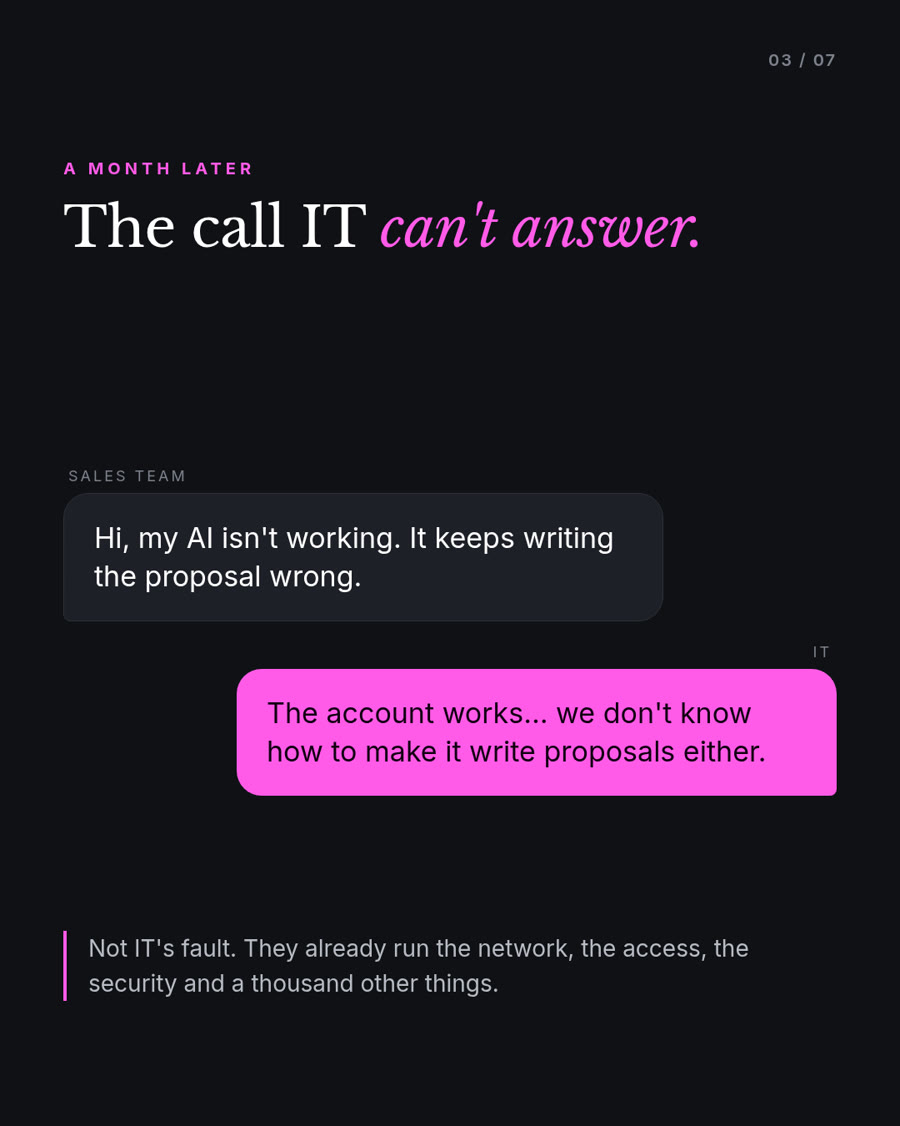
Then a month goes by. Someone in sales calls IT: "My AI isn't working. It keeps writing the proposal wrong." IT checks the account. The account is fine. They have no idea how to make it write a better proposal, and why would they?
This is the biggest mistake I see management make with AI. They treat it as another IT department.
IT is already full
I want to be fair to IT teams, because this isn't about capability. The IT people I work with are good at what they do. But look at what they already carry: the network, the accounts, the access rights, the security, ports opening and closing, laptops, printers, and a thousand small things nobody notices until they break.
Keeping up with AI is close to a full-time job on its own. The tools change every month. If you add that on top of everything IT already owns, one of two things happens. Either AI gets the leftover time, or the rest of the systems do. Neither is good.
Why it's a skill
AI isn't a system you install once and maintain. It behaves much more like writing, presenting, or working with a spreadsheet. Nobody asks IT to write their emails or build their spreadsheets. IT gives you the software and keeps it safe. The skill of using it well belongs to you.
There are four reasons I think about AI this way.
It lives inside the work. The salesperson uses it on proposals. The engineer uses it on drawings and specs. Finance uses it on month-end reports. Marketing uses it on campaign ideas. Every use is different because every job is different, and the best use of AI in each team only becomes visible to the people doing that work.
Only the expert can judge the answer. AI gives you an answer quickly. Whether the answer is right is a different question. IT can't tell you whether a sales proposal will win the client, or whether a drawing will pass inspection. The salesperson can. The engineer can. If the people who know the job aren't the ones using AI, nobody is checking the output that matters.
It keeps changing. What worked three months ago has been replaced by something better. A skill you practise keeps up with that. A one-time rollout doesn't.
You learn it by doing it. Nobody becomes good at AI by reading a policy document. People get good at it by using it every week on their own tasks, making mistakes, and sharing what worked.
What IT still owns
None of this pushes IT out. IT has a real and important role, just a different one:
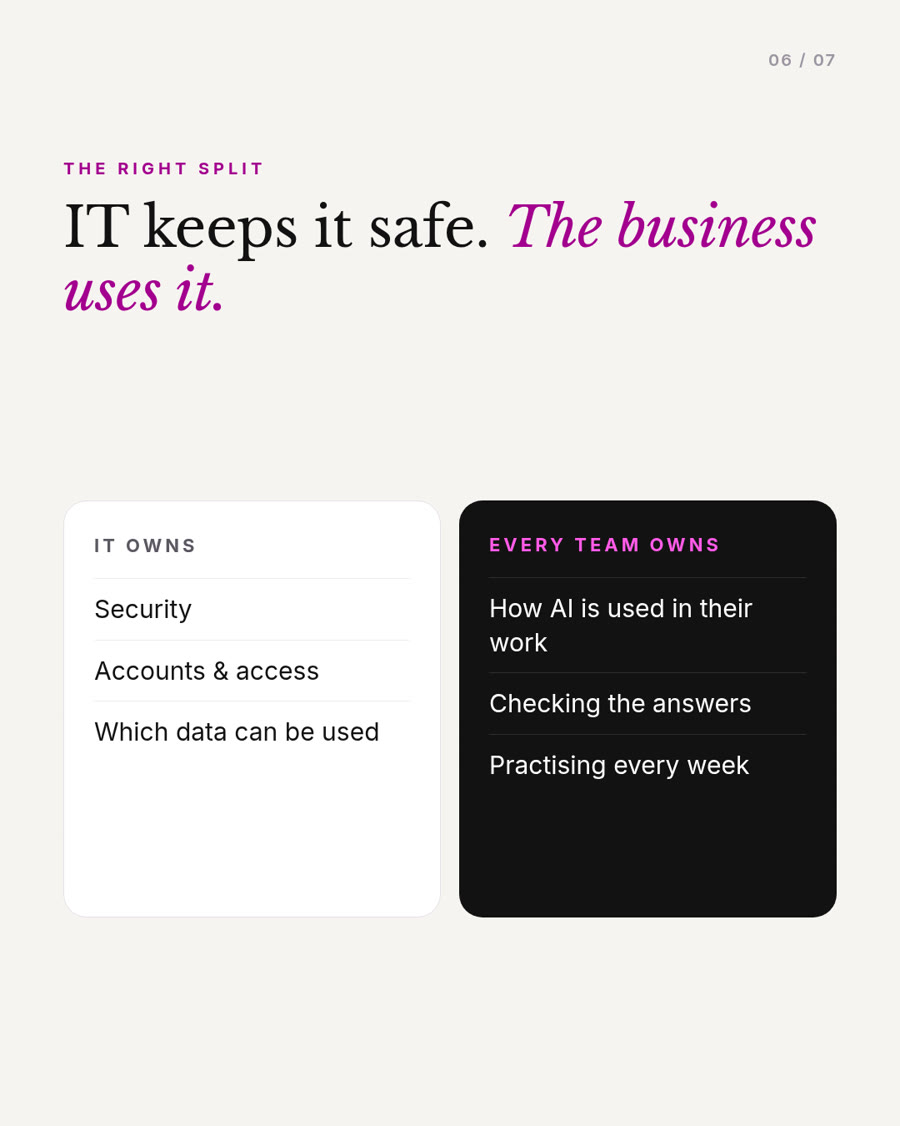
- Security: which tools are approved and how they connect to company systems.
- Accounts and access: who gets what, and who loses access when they leave.
- Data rules: what information is allowed into which tool, and what never leaves the company.
That is a big job, and it's the right job for IT. How AI is used in each team's daily work is not their job, and it shouldn't be.
How we run it across our ventures
In our group, we run AI in three steps.
One person owns AI
Not as an extra line in someone's IT job description. One person whose job is to keep up, lead it, and make decisions quickly. When nobody owns it, it drifts.
An AI committee with every department at the table
One person from sales, one from operations, one from finance, one from marketing, plus management. They meet regularly to share what each team tried, what worked, and what to stop. This is where a good idea from one team becomes a habit across the company, and where management makes the calls on budget and direction quickly.
Training for everyone
Not a single workshop. Ongoing practice, on people's own real work, so the skill builds the same way any other skill does.
The committee is what makes the difference. Without it, you get one enthusiastic person in one department and silence everywhere else. With it, every department is learning at the same time, and from each other.
Where to start
If AI in your company currently sits with IT, you don't need a reorganisation to fix it. Start small:
- Name one owner this week.
- Ask each department head for one person to join a small AI group.
- Have each department pick three real tasks to try with AI this month, and track the time saved.
- Let IT write the data rules, and make sure everyone knows them.
Then meet every two weeks and keep going.
AI doesn't belong to one department. It belongs to everyone who does the work.
How is it handled in your company today? I'd like to hear what's working for you.
Hafez AlSayed is the founder and Group CEO of Utopia Global Ventures, a Dubai holding group of nineteen ventures that runs with AI agents in real roles.